Streaming When Your Chat Is Quiet: How to Avoid Dead Air and Keep Viewers Engaged

Updated: 15 hours ago
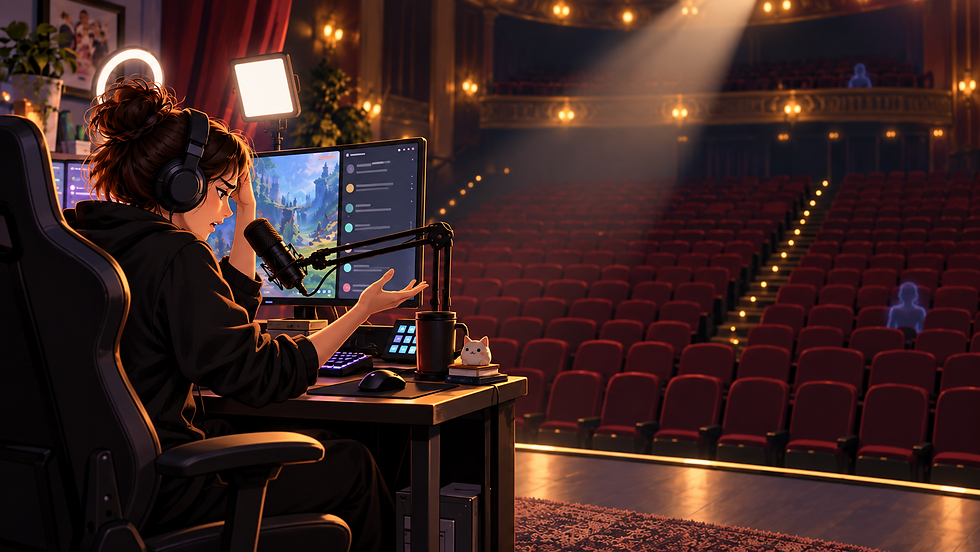
What to Say When Nobody Is Talking on Twitch
Streaming to a quiet chat can feel strange, especially when you are new.
You go live, start playing your game, glance over at chat, and nothing is happening. No messages. No questions. Maybe your viewer count says one person is there. Maybe it says zero. Either way, the silence starts getting loud.
The biggest mistake you can make in that moment is waiting for someone else to give you something to talk about.
When your chat is quiet, your job is not to wait for conversation. Your job is to create the conditions where conversation can happen.
That starts with one simple skill: learning how to talk even when nobody is talking back.
Stream Like Someone Is Watching, Even When Chat Is Quiet
One of the best things you can do when your chat is quiet is use your imagination.
Imagine someone is there.
More importantly, remember that someone actually may be there.
Viewer counts are not always the best way to tell who is actively watching at any given second, and plenty of people lurk without saying anything.
Some viewers are also sizing you up.
They may be trying to decide whether they like your personality, whether they want to stay, or whether they feel comfortable enough to say something.
That means silence does not necessarily mean nobody is listening.
So talk anyway.
You have to stream in two directions at once: like nobody is watching and like everybody is watching.
Stream like nobody is watching so you can relax, stop worrying about judgment, and let yourself be yourself.
But stream like everybody is watching so you still give the stream your full effort.
Do not wait for a larger audience to become entertaining. The stream you want people to discover has to exist before they discover it.
Narrate What You Are Already Thinking
If you do not know what to say while streaming, start with narration. You do not need to invent a fascinating topic every five minutes. You already have thoughts while you are playing.
Say them out loud.
If you are racing, say:
“I’ve got one lap left. I need to hold this lead.”
If another player is trying to knock you off the road:
“What is this guy doing? He is absolutely trying to take me out.”
If you have been running across a giant map forever:
“This is taking much longer than I thought.”
That is narration.
You are simply externalizing the thoughts you were already having. The screen is constantly giving you something to react to. Your controller vibrates. Your character takes damage. You almost fall off a cliff. You finally defeat the boss you have been fighting for twenty minutes.
React.
If something funny happens, ride with it.
If you have a goal in the game, tell people what the goal is.
If you make a mistake, talk about why you made it.
You do not have to describe every button you press or fill every second with noise. You are just giving the audience access to the experience happening inside your head.
That alone can make a quiet stream feel much more alive.
Quiet Moments Are Fine. Dead Air Is Different.
You do not have to talk every second.
Some streams have a comfortable lurking energy. People may be working, cleaning, gaming themselves, or simply keeping you on in the background. They may not be able to focus on you continuously.
That is normal.
Good streams still have natural pauses.
The difference is between a pause and a stream that feels abandoned.
If you go quiet for a few seconds because you are concentrating, that can feel natural.
If you stop talking for thirty minutes because nobody in chat said anything, the stream may start feeling empty.
When in doubt, say a little more rather than a little less.
You do not need to force constant chatter, but you should keep enough rhythm in the stream that somebody entering knows there is a person actively hosting it.
Use a Question of the Day to Restart Conversation
One of the easiest tools for a quiet chat is a question of the day.
Choose something open-ended enough that people cannot answer with only yes or no.
You can put the question in your stream title, pin it in chat, keep it written beside you, or simply bring it back whenever the conversation slows down.
The important part is that you are not asking the question once and then throwing it away if nobody answers.
People come and go throughout a stream.
Someone who arrived twenty minutes later never heard the first time you asked it.
So ask again.
If someone new comes in, you can bring the question back naturally. If chat was active earlier and becomes quiet, return to it.
You can also answer your own question.
That keeps you from putting pressure on chat to rescue the conversation.
Do Not Turn the First Chatter Into Your Entire Audience
This is one of the easiest traps for small streamers to fall into. You have been talking to yourself for twenty minutes. Finally, somebody types something.
Suddenly you are thrilled.
Now every question goes to that person.
What did you eat today?
What game are you playing?
Where are you from?
What are you doing later?
Meanwhile, that viewer may be thinking, “I only wanted to say hello.”
A person who chats should feel welcomed, not recruited into a full-time position.
Remember that other people may still be watching quietly.
Read what the chatter says. Respond to it. Piggyback off their message if it naturally creates a conversation.
But keep doing the other things you were already doing.
Continue narrating the game. Continue your topic. Ask occasional questions. Let the conversation breathe.
If that person becomes quiet again, let them.
Lurking should always feel allowed.
Do Not Assume Silence Means Your Topic Failed
This is where your imagination can work against you.
You ask a question.
Nobody answers.
Now your brain starts writing a story:
“That was a bad topic.”
“They think I am boring.”
“Everybody left.”
You do not know that. Someone may be at work. Someone may have stepped away. Someone may be listening without typing.
They may not have heard the question.
Your music may be too loud.
Your mic could be lower than you realized.
Your displayed viewer count may not even reflect exactly what is happening at that moment.
You cannot know what you do not know.
So do not treat every lack of response as a verdict.
If you still have something interesting to say about the topic, keep talking.
If the moment feels ready to move on, move on.
But do not let an invisible audience convince you that you failed when you have no actual evidence that anything went wrong.
Keep an Eye on Chat Without Becoming Obsessed With It
Another mistake small streamers sometimes make is becoming so used to an empty chat that they stop looking at chat altogether.
Then someone finally says something and the streamer misses it.
If your chat is hard to see while you are streaming, fix your workspace.
If you use OBS, make the chat dock large enough to read comfortably. Keep your Twitch activity feed visible when possible so you can catch follows, raids, channel point redemptions, watch streaks, and other activity that gives you an opportunity to interact.
You do not need to stare at chat every second.
But you should glance at it regularly enough that people do not feel ignored.
At the same time, consider hiding your live viewer count.
That number can become a spotlight that only you can see.
You say something and the number drops. Now you think you said the wrong thing.
The number rises. Now you start trying to recreate whatever you think caused it.
That can pull your attention away from actually doing a good stream.
The viewer count does not need to direct your personality.
Make the Stream Feel Comfortable for Lurkers
A quiet stream does not automatically mean a bad stream.
Some viewers deliberately look for streams that feel comfortable enough to lurk in.
That comfort starts with the streamer.
People can feel when you are relaxed. They can also feel when you are frustrated, defeated, irritated, or uncomfortable.
Your visual setup can help. Good lighting, a clear camera, an appealing overlay, and an organized stream all contribute to the atmosphere.
But your energy matters more.
You set the emotional temperature of the room.
Community behavior matters too.
A newcomer may hesitate to speak if the stream feels cliquish, if the streamer only talks to their friends, if a mod acts territorial, or if another chatter is making everyone uncomfortable and nobody addresses it.
You want somebody to be able to enter quietly, stay quietly, talk when they feel like it, and disappear back into lurking without being questioned about where they went.
That freedom can actually make people more likely to talk.
Your Personality Does Not Have to Be Loud
You do not need to become a completely different person to become better at streaming.
Some streamers are naturally loud, funny, musical, energetic, or quick on their feet.
Other streamers are quieter.
Some people want the spicy personality. Some people want mild.
A quieter streamer can build a warm, calm, cozy community and still be excellent at what they do.
The skill you need is not “become louder.”
The skill is learning how to express more of what is already happening inside you.
Practice talking out loud to yourself.
Practice narrating games when you are not live.
Practice telling stories.
Practice streaming by streaming.
You become more comfortable through repetition.
The art is in the hand, not the pencil. Great equipment can make your stream look better, but it cannot replace the person behind it.
You are the content.
Try This for Your Next Three Streams
If your chat is usually quiet, give yourself three streams to work on these three things:
1. Practice narration.
Say your thoughts out loud while you play. Explain your goals, reactions, decisions, mistakes, and funny moments.
2. Pre-plan a little.
Prepare a question of the day, a few conversation prompts, or a small list of topics you can return to when things get quiet.
3. Review the stream afterward.
Watch parts of your VOD. Notice where you were comfortable, where you went silent, where conversation flowed naturally, and where you missed opportunities to interact.
Then use what you learned in the next stream.
A quiet chat does not mean you have nothing to work with.
It means you are still learning how to create a room people want to enter.
Talk. React. Narrate. Make the room comfortable.
And give people something worth listening to before they ever decide to type.


Comments